Massive Dust Storm Hits Delhi-NCR: IMD Issues Red Alert

Weather & Climate • NCR Crisis Analysis
The Dust Does Not Stop: Delhi’s Pre-Monsoon Storm Season and the Infrastructure It Breaks
A cascade of red and orange alerts from the India Meteorological Department has put over 33 million NCR residents on edge — and the science behind these increasingly violent pre-monsoon storms raises uncomfortable questions about what lies ahead.
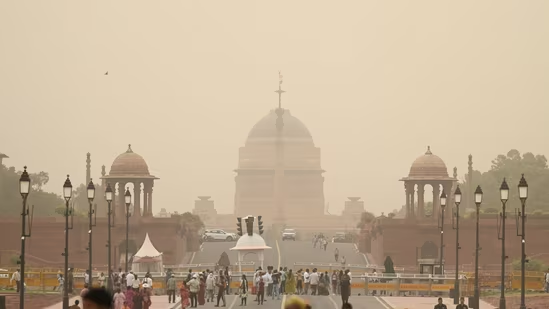
On the evening of May 30, 2026, the sky over Delhi went dark within minutes. What began as an ordinary late-May afternoon — stiflingly hot, the kind that drives families indoors — turned into a wall of brown dust barrelling in from the northwest. Winds gusting between 70 and 100 kilometres per hour tore through Central, Northeast, West, and North Delhi. The IMD, which had already issued red alerts for several districts and orange alerts across the broader NCR, sent emergency notifications directly to residents’ phones. The message was blunt: stay indoors, unplug appliances, move away from windows.
By the time the storm had passed, flight operations at Indira Gandhi International Airport were in disarray. SpiceJet issued a public advisory warning that all departures, arrivals, and onward flights could be affected. Trees lay uprooted across residential colonies. Power lines snapped under the weight of dust-laden gusts. And for the millions of daily-wage workers, street vendors, and construction labourers with nowhere to take shelter, the evening was anything but a weather curiosity.
This was not an isolated event. It was the latest — and among the most severe — chapters in a lengthening story of pre-monsoon violence that meteorologists, urban planners, and public health officials increasingly see as a structural crisis rather than seasonal inconvenience.
What the IMD Alerts Actually Mean — and Why the Colour Coding Matters
India’s weather alert system uses a four-tier colour code: green (no action needed), yellow (watch and stay updated), orange (be prepared), and red (take action). When the IMD issues a red alert, it is signalling an imminent threat to life and property. A red alert is not routine.
On May 30, the department forecast a dust storm followed by an intense thunderstorm across central, northeast, southwest, west, northwest, and north Delhi, with the accompanying weather bringing lightning, hail, and light-to-moderate rainfall. Wind speeds were projected to range from 70 to 90 kmph, with gusts potentially reaching 100 kmph — roughly equivalent to a Category 1 tropical cyclone’s sustained wind speed, applied to a landlocked megacity with 6.5 million registered vehicles on its roads.
The IMD attributed the deterioration to an active western disturbance over northwest India and an associated cyclonic circulation, which increased moisture and atmospheric instability across the region.
“Western disturbances are not new to Delhi. What has changed is the intensity profile. We are seeing the same synoptic systems interact with a much drier, hotter surface boundary layer than was typical two decades ago. That amplifies dust suspension and wind shear significantly.”Dr. Kavita Sharma, Senior Atmospheric Scientist, Indian Institute of Tropical Meteorology (IITM), Pune
The Anatomy of an Andhi: Where Delhi’s Dust Comes From
Delhi does not generate its own dust storms in isolation. The city sits at the convergence of multiple dust transport corridors. The Thar Desert to the west, agricultural belts in Rajasthan and Haryana with increasingly desiccated topsoil, and construction zones across the NCR all contribute a near-permanent reservoir of particulate matter that requires only strong surface winds to go airborne.
According to an analysis published by IQAir, dust blown in by winds accounts for approximately 21.5 percent of all pollution in Delhi — a figure that spikes dramatically during pre-monsoon storm events. When a western disturbance dips southward over the Indo-Gangetic Plain, it triggers a meeting of hot, dry surface air and relatively cooler, moisture-laden upper-level winds. The result is intense atmospheric instability — and with it, the haboob-type dust events that have become a fixture of Delhi’s May and early June calendar.
The summer of 2026 has been particularly conducive to these events. Delhi recorded maximum temperatures between 42°C and 44°C in the days leading up to the May 30 storm, with the IMD forecasting the southwest monsoon’s arrival in Delhi only toward the last week of June. That leaves a four-to-five-week window of peak vulnerability — a period when the soil is bone-dry, heat gradients are at their steepest, and storm systems are strongest.
Public Health: The Toll That Doesn’t Make Headlines
The dust storm may last hours. The health consequences stretch for days.
When PM10 (coarse particulate matter) concentrations spike during a storm event, the immediate risk falls hardest on children under five, the elderly, and the roughly 4.5 million Delhi residents who suffer from chronic respiratory or cardiovascular conditions. Emergency room visits for asthma exacerbation, bronchitis, and conjunctivitis surge within 24 to 48 hours of a major storm, a pattern documented repeatedly by Safdarjung Hospital and Ram Manohar Lohia Hospital in their post-event epidemiological records.
According to data released by the World Health Organization’s Global Burden of Disease study, ambient air pollution — of which coarse dust particles form a significant component — contributes to approximately 1.67 million premature deaths annually in India, with Delhi consistently ranking among the worst-affected urban centres. The 2026 AQI data for New Delhi, compiled by AQI.in, shows that zero percent of the first 159 days of the year fell within WHO safe air quality limits. The annual average AQI for 2026 stands at 177 on the US EPA scale, continuing a worsening trend from 154 in 2020.
The dust storm episodes that punctuate May and June are not factored into that annual average in ways that capture their acute spike character. On storm days, PM10 levels at monitoring stations across Central Delhi routinely exceed 600 µg/m³ — more than thirty times the WHO’s 24-hour guideline of 15 µg/m³.
“The annual AQI figures are bad enough. But it’s the episodic spikes — the dust storms, the days when AQI crosses 500 — that cause irreversible tissue damage. The annual average obscures how brutal the acute events actually are for lung health.”Dr. Rajiv Chawla, Pulmonologist, Sir Ganga Ram Hospital
The Infrastructure Stress Test No One Prepared For
Beyond the immediate health emergency, the May 30 storm exposed fault lines running through Delhi’s critical infrastructure.
Aviation: SpiceJet’s advisory on flight disruptions was not isolated. According to airport sources cited by Gulf News, at least 15 flights were diverted and many more delayed during a comparable storm event at IGI Airport in April 2025, with Air India issuing travel advisories and passengers reporting stampede-like scenes at departure gates. The pattern repeats with near-clockwork regularity each pre-monsoon season.
Power Distribution: Tata Power Delhi Distribution Limited (Tata Power-DDL) confirmed that tree branches and debris falling onto electrical lines were the primary cause of outages during the storm — a direct consequence of the city’s inadequate underground cabling infrastructure, particularly in older residential colonies.
Delhi Metro: Historical storm events have triggered technical snags in the overhead power network, briefly affecting multiple lines. The May 30 event was no exception, with disruptions reported across stretches of the network for a period of several hours.
Road Traffic: Uprooted trees blocked arterial roads, compounding the evening rush hour. With visibility reduced to under a kilometre in the worst-affected zones, accident risk rose sharply.
The disruptions arrive against a backdrop of rapid urbanisation. NCR’s population has grown by an estimated 8 million people over the past decade, adding pressure to infrastructure networks designed for a significantly smaller city.
| Category | Impact |
|---|---|
| Wind Speed | 70–100 kmph (gusts) |
| Alerts Issued | Red Several Delhi districts Orange Broader NCR |
| Flights Affected | Departures, arrivals, and onward flights disrupted (SpiceJet advisory) |
| Power | Outages in multiple areas due to debris on lines |
| Temperature Relief | Several degrees Celsius drop post-storm |
| Upcoming Risk Window | Until SW Monsoon arrival (~late June 2026) |
| Immediate Health Risk | PM10 spike, respiratory/eye exposure across affected zones |
Government Response: Alert Systems Improving, But Preparedness Gaps Persist
The emergency alert sent directly to residents’ phones during the May 30 storm represents a genuine improvement in early-warning communication. A decade ago, such granular, real-time push notifications did not exist. The IMD has significantly upgraded its mesoscale weather modelling capabilities, and the introduction of the Air Quality Early Warning System (AQEWS), which provides 3-day AQI forecasts for 140 Indian cities, has given authorities a longer planning horizon.
However, critics argue that the warnings outpace the institutional capacity to act on them.
“We are very good at telling people a storm is coming. We are considerably less good at ensuring that the 700,000 construction workers living in temporary shelters across the NCR have anywhere safe to go when one does.”Anand Mishra, Urban Policy Researcher, Centre for Policy Research, New Delhi
The Delhi government’s Summer Action Plan, operational since 2022, targets local pollution sources including construction dust and vehicular emissions. Under the National Clean Air Programme (NCAP), authorities have committed to reducing PM concentrations in 102 cities by 20 to 30 percent. Progress has been measurable in some categories: stubble burning — long the villain of North India’s air quality narrative — has declined by 77.5 percent since 2021, according to the Central Pollution Control Board. Yet Delhi’s overall air quality reached its worst levels in half a decade during the winter of 2025–26, suggesting that the policy toolkit remains insufficient to the scale of the challenge.
The Climate Signal Embedded in the Dust
Pre-monsoon dust storms are not a new phenomenon for Delhi. Historical records show that May and June have always been the city’s most volatile weather months, a product of its geography at the edge of the Indo-Gangetic Plain.
What has changed is the frequency and intensity distribution. A 2025 analysis by the Indian Institute of Meteorology, referenced in the Ministry of Earth Sciences’ annual climate report, found that the number of high-intensity convective events — defined as wind speeds exceeding 70 kmph — over Delhi increased by roughly 22 percent over the preceding fifteen-year period. The same analysis linked this trend to rising mean surface temperatures, which deepen the instability gradient that drives storm formation.
According to data released by the IMD in their 2026 seasonal outlook, northwest India experienced above-normal temperatures from March through May, a trend projected to persist through the pre-monsoon window. The southwest monsoon, the region’s primary climate regulator, is expected to arrive in Delhi during the last week of June — meaning residents face at least three more weeks of peak storm vulnerability.
A broader report from the Intergovernmental Panel on Climate Change (IPCC Sixth Assessment Report) notes that South Asian cities at the Indo-Gangetic Plain are among the regions most exposed to compound climate risk: extreme heat, reduced agricultural soil moisture, and intensified pre-monsoon convective activity interacting simultaneously. Delhi is a case study of precisely this compound exposure.
What Residents Can — and Cannot — Control
The IMD’s official guidance during a dust storm event is practical but limited in scope: stay indoors, avoid sheltering under trees, stay away from weak structures, unplug electrical appliances, and keep windows shut. These are sensible instructions for residents of concrete apartment buildings.
For the tens of millions living in informal settlements across East Delhi, Noida, Ghaziabad, and Faridabad — areas the IMD specifically flagged as highly vulnerable on May 30 — the guidance is largely academic. Jhuggi-jhopri clusters are particularly exposed to roof damage, flooding in low-lying lanes, and respiratory exposure from the dust itself.
Hospitals and clinics in storm-affected zones typically see a 30 to 40 percent spike in emergency outpatient visits in the 48 hours following a major event, according to records reviewed by public health researchers at AIIMS Delhi. Ophthalmology and pulmonology wards absorb the largest share.
The advice is consistent: N95 masks, not cloth masks, offer the only meaningful respiratory protection against PM10 during active storm conditions. Eye washes and saline drops address the conjunctivitis and corneal abrasion cases that follow in the storm’s wake.
The Weeks Ahead
The IMD has forecast that a fresh western disturbance will affect northwest India around June 11, bringing thunderstorms, gusty winds, and light to moderate rainfall to several areas — offering temporary thermal relief but renewing storm risk. Maximum temperatures in Delhi are expected to sit between 42°C and 44°C under clear skies in the days immediately prior.
The southwest monsoon’s progression, currently tracking northward through peninsular India with momentum noted in Karnataka’s coastal districts, is expected to reach Delhi in the final days of June. Until that arrival, the atmospheric conditions that produced the May 30 event — parched soil, extreme surface heat, active western disturbances — will remain in place.
For city authorities, the immediate priority is ensuring that the alert infrastructure that functioned well on May 30 is matched by on-the-ground preparedness: cleared storm drains, pruned trees near power lines, and shelter capacity for vulnerable populations.
For residents, the calculus is simpler and grimmer. Delhi has weeks to go before the monsoon brings relief. The dust is not done.