How the Rejection of Meenakshi Natarajan’s Rajya Sabha Nomination Became India’s Hottest Political Flashpoint

The Nomination That Shook New Delhi: Inside the Meenakshi Natarajan Controversy
The Sequence That Shocked New Delhi
It began with a procedural objection and ended with a political firestorm.
On June 9, 2026, the nomination of Meenakshi Natarajan — the Indian National Congress’s sole candidate for the Rajya Sabha biennial election from Madhya Pradesh — was rejected by the state’s returning officer. The grounds cited: an alleged failure to disclose a pending legal case in her nomination papers.
Within hours, Congress MPs had descended on the Election Commission of India’s offices in New Delhi. The planes carrying party MLAs to Bengaluru — part of a standard anti-poaching strategy before upper house polls — were recalled from the runway.
A routine Rajya Sabha contest had turned into a constitutional confrontation.
What the Records Show
The rejection came following complaints that Natarajan had failed to disclose details of a case against her in her nomination papers, dramatically altering the political landscape ahead of the Rajya Sabha contest.
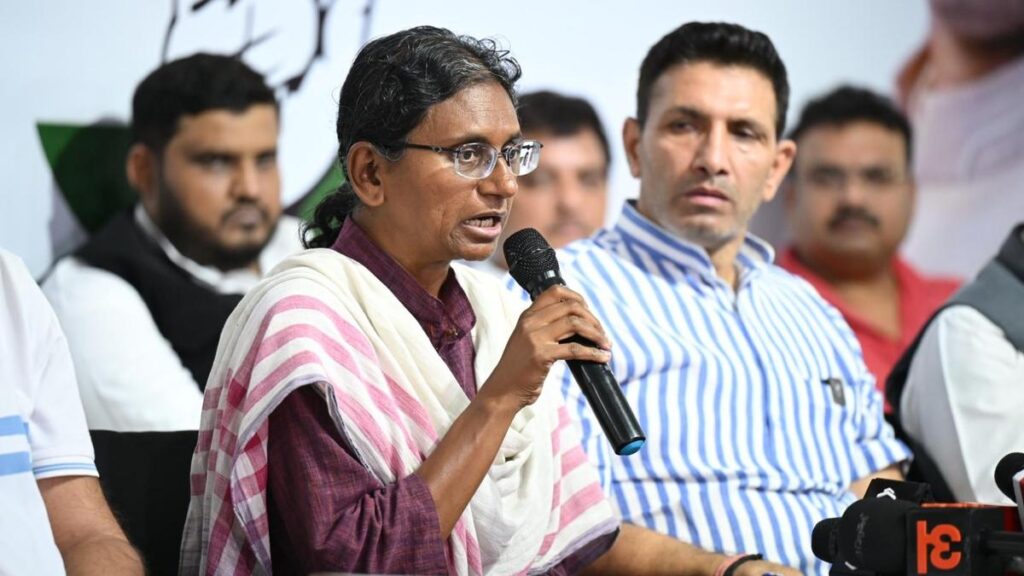
At a press conference, Natarajan accused the BJP of “attempting to manipulate the Rajya Sabha election,” alleging that the ruling party had “subverted elections in Madhya Pradesh” before. She pointed to the BJP fielding a third candidate despite lacking the requisite numerical strength as the opening move in this strategy.
The BJP’s own response was unguarded. Kailash Vijayvargiya, senior BJP leader, remarked that the information leading to the rejection “must have been Congress people who gave us” — a statement that Congress quickly amplified as evidence of the party’s knowledge of, if not hand in, the process.
“Attempting to manipulate the Rajya Sabha election… subverted elections in Madhya Pradesh before.”
— Meenakshi Natarajan, INC Candidate, at press conferenceThe Smriti Irani Echo — Why Opposition Memory Is Long
Congress leaders were quick to draw a comparison that resonated far beyond Bhopal.
In the 2024 Lok Sabha elections, BJP’s Smriti Irani had her Amethi campaign paperwork contested and scrutinised — yet her nomination sailed through without incident. That election, of course, ended with Irani losing to Congress’s Kishori Lal Sharma by a decisive margin. But the contrast in treatment — Irani’s papers accepted, Natarajan’s rejected — is one Congress has seized upon to argue systemic asymmetry.
“The message being sent is clear,” said Priya Dutt, a senior Congress spokesperson. “The rules of the game change depending on which jersey you’re wearing.”
Electoral law analysts, however, note that this argument cuts both ways. Dr. Vikram Mehrotra, a constitutional law researcher at the National Law School of India University, points out that “disclosure requirements in election affidavits have been increasingly weaponised across party lines. The question is not whether the law was applied, but whether it was applied selectively and under political pressure.”
“The rules of the game change depending on which jersey you’re wearing.”
— Priya Dutt, Senior Congress SpokespersonThe EC’s Response — and Congress’s Frustration
A Congress delegation went to meet the Election Commission on the evening of June 9, but party leaders said they could not meet officials. The Election Commission later said it had invited a delegation of Congress to meet with the Commission on June 10.
That 24-hour delay, in the context of a June 18 polling date, is not trivial. It compresses the legal window for appeal. According to a report by the Association for Democratic Reforms (ADR) published in April 2026, nomination rejections in upper house elections have increased by 34% over the past decade, with a disproportionate number affecting candidates from opposition parties in BJP-governed states.
MP, Surat, and the Normalisation of “Procedural” Defeats
This is not the first time Madhya Pradesh has been at the centre of such a controversy.
In the 2024 Lok Sabha elections, Congress candidate Akshay Kanti Bam withdrew his nomination from Indore at the last moment and joined the BJP — a move Congress described as coerced. Before that, the Surat Lok Sabha seat saw BJP win uncontested after the Congress nominee’s papers were rejected on technical grounds.
A pattern is forming that alarm bells among electoral observers. Each incident, in isolation, can be explained by procedure. Together, they suggest something more corrosive.
“When these incidents cluster in opposition strongholds or in seats where the BJP faces genuine competition, it moves beyond coincidence into the realm of systemic concern.”
— Nilufar Rashidova, Independent Election Analyst, Carnegie Endowment for International PeaceCongress’s Strategic Position — and Its Vulnerabilities
Telangana Chief Minister Revanth Reddy condemned what he called “the conspiracy by the BJP in Madhya Pradesh,” calling the development “an assault on democracy” and pledging Congress would “fight this with all its might.”
Congress MP Jairam Ramesh said the rejection “amounts to an assault on democracy,” accusing BJP of stooping low after “realising their dirty tricks to compromise our MLAs were going to fail.”
But Congress’s position is not without complications. The party did not cross-verify Natarajan’s affidavit with the same rigour one might expect of a professional legal team before submission. Internal party sources, speaking off the record, acknowledge that the oversight — whatever its scale — handed the BJP a procedural lever.
The real political damage is less about this one seat and more about the narrative heading into the 2027 state election cycle. If Congress cannot protect its candidates’ nominations from procedural challenge in states where BJP controls the administrative machinery, it faces a structural disadvantage that no amount of rally attendance can compensate.
What Comes Next
The Rajya Sabha election is scheduled for June 18. With Natarajan’s candidacy now in legal limbo, Congress is weighing an emergency petition before the High Court. Legal observers say the timeline is tight but not impossible.
The Election Commission operates under strict constitutional mandates that theoretically insulate it from political interference, but critics argue that the body’s responsiveness in contested cases has varied significantly based on which party is in power at the Centre.
For voters watching from the outside, the episode reinforces a troubling question: when procedural rules become political tools, who is left to enforce the rules about the rules?
| Candidate | Meenakshi Natarajan (INC) |
| Election | Rajya Sabha Biennial, Madhya Pradesh |
| Polling Date | June 18, 2026 |
| Grounds for Rejection | Non-disclosure of pending case in affidavit |
| BJP Response | Vijayvargiya implied Congress’s own people flagged it |
| Congress Action | EC delegation + legal challenge being planned |
| Comparison Drawn | Surat 2024, Indore 2024 |