The Cockroach Revolution: Why India’s Stressed Students Are Using Satire to Fight Exam Scams

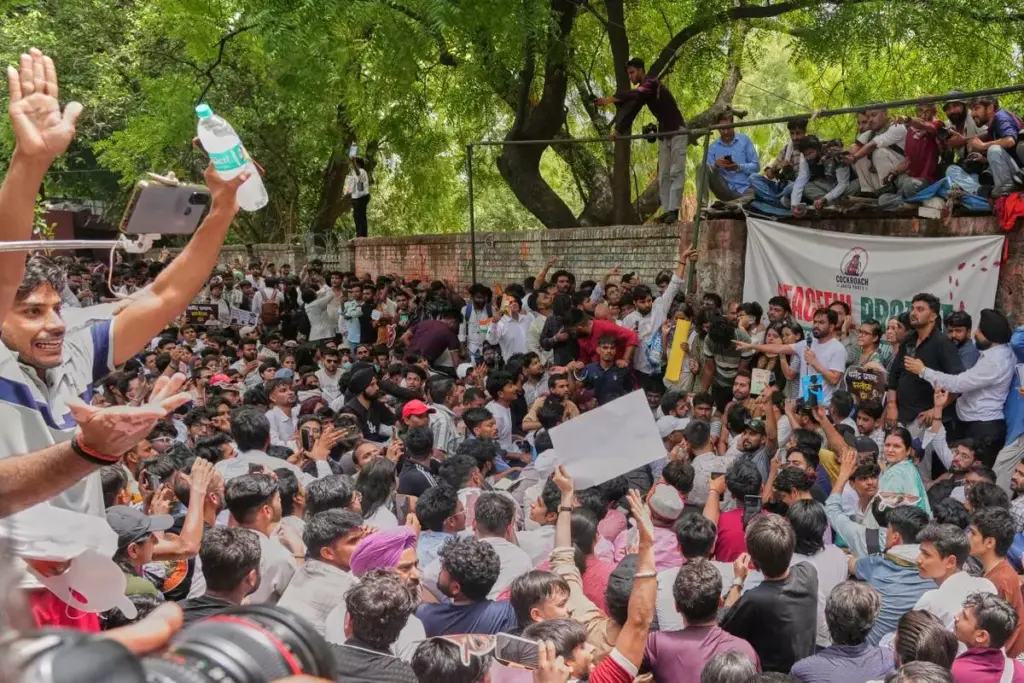
The sweltering June heat at Jantar Mantar, Delhi’s historic protest ground, is usually cut by familiar political slogans, standard party flags, and organized labor unions. Over the weekend, however, the landscape transformed into an absurd, striking theater of dissent. Thousands of young demonstrators gathered under a sea of giant cockroach masks, waving placards that read: “We asked for ‘Make in India’, you gave us ‘Leak in India’.”
This unorthodox demonstration was orchestrated by the Cockroach Janta Party (CJP), a satirical political collective that has rapidly morphed from a viral internet meme into a potent vehicle for youth rage. The primary catalyst for this escalation is a systemic crisis threatening India’s highly competitive national examinations, specifically the National Eligibility cum Entrance Test (NEET-UG) and administrative irregularities managed by the National Testing Agency (NTA).
What began as online digital commentary has officially crossed over into disruptive physical mobilization. The phenomenon exposes deep structural fractures within India’s educational architecture, public accountability systems, and the economic future of its Gen Z demographic.
From Judicial Analogy to Streets of Discontent
The genesis of the Cockroach Janta Party traces back to a sharp flashpoint within India’s legal infrastructure. On May 15, 2026, during a Supreme Court hearing examining fraudulent professional credentials and institutional efficiency, a bench led by Chief Justice Surya Kant drew a sharp analogy. In an effort to criticize individuals pushing fraudulent credentials, the judicial observation inadvertently compared confrontational, chronically online, and underemployed youth to highly resilient, ubiquitous insects.
The remark deeply struck a chord with a young population already grappling with an increasingly volatile job market. Within 24 hours, Abhijeet Dipke, a digital communications strategist and former political staffer, inverted the phrase. He launched the “Cockroach Janta Party” online as a parodic counter-front, publishing an artificial intelligence-assisted manifesto under the tagline: “Voice of the Lazy & Unemployed.”
The growth curve of the movement was unprecedented. Within five days, the group’s Instagram handle surged past 20 million followers, briefly eclipsing the primary digital footprints of several established traditional political organizations.
While initially viewed by political analysts as a transient digital trend, the escalating structural crisis surrounding the NTA injected severe real-world urgency into the group’s agenda. The national conversation rapidly pivoted from a critique of judicial tone to a full-blown crisis over the fairness of India’s centralized testing regime.
The NTA Structural Failure and the NEET-UG Crisis
The immediate focus of the CJP’s street mobilization centers on deep administrative lapses within India’s centralized testing infrastructure. The National Testing Agency, established to streamline and secure competitive national admissions, faces intense public scrutiny following systemic leaks and technical malfunctions during high-stakes examinations.
The friction intensified following major disruptions, grading irregularities, and confirmed paper leaks tied to the NEET-UG medical entrance framework—the primary gateway for millions of aspiring doctors. With exams rescheduled for late June 2026 due to compromised security protocols, over two million students were left in professional limbo. Concurrently, reports highlighted significant data discrepancies within the Central Board of Secondary Education’s (CBSE) On-Screen Marking (OSM) systems, severely damaging public trust in automated educational evaluations.
“The system isn’t just leaking; it is fundamentally broken. We are giving the administration a strict seven-day ultimatum. Either the Union Education Minister takes full structural accountability and resigns, or this satirical mobilization will systematically expand into every state capital.”
— Ashutosh Ranka, Spokesperson for the Cockroach Janta Party
An analysis of the administrative failures reveals three major vulnerabilities within India’s current high-stakes examination model:
- Tendering Faults & Third-Party Risks: The outsourcing of digital infrastructure and question-paper distribution to unverified third-party vendors has significantly increased the surface area for data breaches and systemic leaks.
- Flaws in On-Screen Assessment: Technical glitches within automated portals have altered scores, introduced scoring discrepancies, and obscured transparent evaluation metrics.
- Inadequate Redressal Mechanisms: The lack of independent, fast-track audit systems leaves affected students with few immediate paths for dispute resolution, driving them toward public protests.
Multi-Perspective Analysis: The Fractured Response
The rapid rise of an aggressive, youth-led satirical collective has drawn varied reactions across India’s political and socioeconomic landscape.
The Institutional and Governing Viewpoint
Government officials and senior leaders within the ruling establishment have largely dismissed the movement, framing it as an external campaign designed to foster anti-establishment sentiment among impressionable demographics.
Nitin Nabin, a senior leader within the ruling coalition, issued a public caution against the movement’s methods without explicitly naming the group:
“A structured nation cannot operate on satire and digital mockery. Some entities operating outside traditional frameworks assume they can direct the youth of India toward purely negative politics. True nation-building requires disciplined participation within democratic norms, not chaotic campaigns that echo anti-establishment disruptions seen elsewhere in the region.”
The Student and Civil Society Perspective
Conversely, independent education reformers, legal experts, and civil rights advocates view the CJP as a natural response to a prolonged lack of institutional transparency. Climate activist and education reformer Sonam Wangchuk joined the Jantar Mantar demonstrations, lending significant weight to the youth platform.
Public data underscores the high stakes driving this mobilization. According to a 2025 structural assessment by the Center for Monitoring Indian Economy (CMIE), urban youth unemployment within the 20–24 age bracket remains high, compounding the intense anxiety surrounding competitive entrance exams. For many, these standardized tests represent the sole viable pathway toward upward economic mobility. When the integrity of that pathway is compromised, the social contract fractures.
| Stakeholder Group | Core Position / Analytical Argument |
|---|---|
| Government & Officials | Views the movement as a potentially disruptive, anti-establishment campaign that undermines institutional trust. |
| Student & Civil Society | Identifies the satire as a vital, peaceful outlet for systemic frustration over exam leaks and limited job opportunities. |
| Economic & Tech Analysts | Highlights how AI-driven decentralization allows movements to scale rapidly without traditional party funding. |
The Digital Strategy and Economic Lens
From an operational perspective, political scientists highlight how digital tools have democratized political communication. By using advanced artificial intelligence tools to quickly generate logos, manifestos, and scalable online content, a single student with a laptop can bypass traditional party machines. This rapid scaling model presents a new challenge for traditional state mechanisms accustomed to dealing with conventional, top-down opposition parties.
Future Outlook: The Next 12 to 24 Months
The convergence of the Cockroach Janta Party’s unconventional methods with the structural failures of the NTA marks a significant shift in how public dissent manifests in the digital age. Over the next 12 to 24 months, this intersection is expected to reshape two distinct areas of Indian public life:
1. Mandatory Overhaul of National Testing Standards
The administration cannot afford prolonged instability within its primary educational selection engines. Pressure from civil society and decentralized movements will likely force the Ministry of Education to implement strict structural reforms. This could include shifting back to highly secure, offline hybrid models, utilizing military-grade encryption for question banks, and introducing independent judicial oversight for all centralized testing bodies.
2. The Evolution of Satirical Digitized Movements
The long-term survival of the Cockroach Janta Party depends entirely on its ability to translate viral internet visibility into a disciplined, sustainable civil organization. Satirical movements globally—such as Europe’s Pirate Parties or Iceland’s Best Party—often face challenges when transitioning from digital protest to formal legislative politics. Whether the CJP evolves into a registered political party or remains a decentralized digital watchdog, it has established a new blueprint for youth-led political messaging in South Asia.
As Delhi’s summer intensifies, the administration faces a critical choice: treat the “insect insurgency” as a minor, passing digital trend, or acknowledge it as an early, urgent warning sign from a generation losing faith in the systems of institutional meritocracy.
For a closer look at how this movement transitioned from an online internet trend into a large-scale physical demonstration, you can view this on-the-ground report covering the Cockroach Janata Party Jantar Mantar Protest. This video provides direct footage of the demonstrations in New Delhi, featuring interviews with the student organizers and detailing their specific administrative demands regarding the national examination system.