Amit Shah’s Land Port Management System Launch Means for Trade, Security, and the Northeast

India’s Land Port Management System: Digital Infrastructure, Border Security, and the Northeast Opportunity
The LPMS is India’s most ambitious attempt yet to bring its land frontier management in line with the digital infrastructure already standard at airports and seaports. The implications are significant — for border trade, for security, and for India’s ambitions as a regional logistics hub.
The Land Port Management System (LPMS) is a new digital platform aimed at streamlining cargo processing and passenger movement across all of India’s land ports and putting them on par with systems used at major airports and seaports.
The platform provides end-to-end digital workflows for border trade and travel — covering slot booking, payments, tracking, and clearances — and is expected to make border management more interoperable, efficient and transparent by enabling secure, real-time exchange of logistics and regulatory data among multiple agencies and private operators.
The LPMS will be integrated with ICEGATE, the Unified Logistics Interface Platform, and the Motor Vehicle ecosystem.
The Problem at India’s Land Borders
India shares land borders with seven countries — Pakistan, China, Nepal, Bhutan, Bangladesh, Myanmar, and a short stretch with Afghanistan (though operationally irrelevant). Of those, five have active cross-border trade corridors managed through land ports.
For decades, those land ports operated the way they always had: paper manifests, manual stamps, cash transactions, inter-agency information silos, and queues of trucks that sometimes stretched for kilometres. A consignment of perishables crossing from Bangladesh could sit at Petrapole for 48 to 72 hours awaiting simultaneous clearances from customs, immigration, plant quarantine, food safety inspectors, and state government officials — none of whom shared a common digital platform.
The result was predictable. Trade that should have been fast was slow. Cargo that should have been secure was vulnerable to manipulation. Corruption could thrive in the gaps between agencies that couldn’t see each other’s data.
The LPMS Architecture
According to the home ministry, LPMS will provide end-to-end digital workflows for border trade and travel, covering slot booking, payments, tracking, and clearances, and is expected to make border management more interoperable, efficient and transparent by enabling secure, real-time exchange of logistics and regulatory data among multiple agencies and private operators.
The LPMS will be integrated with ICEGATE — the Indian Customs Electronic Gateway used for customs-related electronic filing and data exchange — the Unified Logistics Interface Platform, and the Motor Vehicle ecosystem.
In practical terms, this means a truck driver approaching the Petrapole land port on the India-Bangladesh border can now book a crossing slot online, pay fees digitally, track clearance status in real time, and receive a single integrated clearance rather than collecting stamps from six different offices. The airport analogy is apt: this is the land port equivalent of an e-boarding pass.
ICEGATE: Indian Customs Electronic Gateway — customs-related electronic filing and data exchange
ULIP: Unified Logistics Interface Platform — cross-modal logistics coordination
Motor Vehicle Ecosystem: Vehicle registration and cross-border transit data
The Launch and the Infrastructure Investment
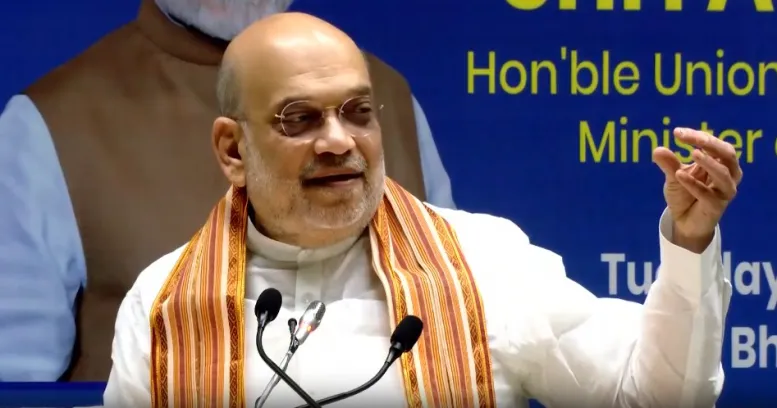
Union Home Minister Amit Shah launched the LPMS to improve border and internal security, underscoring the Modi government’s promise to secure the frontier and promote cross-border trade. Shah said that Prime Minister Modi’s vision has not only made the Land Ports Authority of India “a first layer of security” but also “an agency that makes trade easier and more secure.”
Beyond the digital launch, Shah also inaugurated brand-new stakeholder accommodation facilities at the Dawki Land Port in Meghalaya and the Srimantapur Land Port in Tripura, giving a direct infrastructure boost to border security personnel and local operators.
Dawki is the principal land crossing point on the India-Bangladesh border in Meghalaya. Srimantapur, in Tripura, is one of the few crossings in the Northeast that handles significant bilateral cargo. Both are strategic nodes for northeastern trade.
Section 4 · Operational Scope
The Scale of What LPAI Now Oversees
The Land Ports Authority of India currently operates 15 land ports across India’s international borders. Together, these 15 ports handle cargo worth billions of dollars annually. Petrapole alone — the busiest land port in South Asia by cargo volume — processes over 500 trucks per day during peak seasons.
Bringing all 15 under a single digital architecture is not a minor IT upgrade. It is a logistics transformation.
Why the Northeast Is the Real Story
The political and economic significance of the LPMS is most visible when viewed through the lens of India’s Act East Policy and the Northeast in particular.
States like Tripura, Meghalaya, and Manipur have historically been disadvantaged by their geography — surrounded by international borders, distant from major Indian ports, and reliant on a single highway corridor that creates supply chain fragility. The Agartala-Akhaura land port, connecting Tripura to Bangladesh’s rail network, opened the theoretical possibility of Tripura being a transit hub rather than a dead end.
Investments in digital border infrastructure and modern land port facilities can strengthen regional connectivity, boost commerce, and support economic growth across the Northeast. Tripura serves as one of Northeast India’s most important gateways for trade with Bangladesh.
“The LPMS is the missing middleware between India’s ambitious connectivity rhetoric and its operational reality at land borders. Real-time slot booking and single-window clearance could cut dwell times at northeastern ports by 40 to 60%, based on what similar systems achieved at JNPT and Chennai Port.”
— Prabhash Ranjan, Professor of International Trade Law, South Asian University, New DelhiA 2025 report by the Asian Development Bank on South Asian trade corridors estimated that reducing non-tariff barriers at India’s land borders with Bangladesh, Nepal, and Bhutan could increase bilateral trade across those corridors by up to 60% within five years. The LPMS directly addresses several of the non-tariff friction points the ADB identified.
Security Without Sacrificing Speed
Land borders present a dual mandate that airports do not quite replicate. Passenger and cargo processing must be efficient for trade. But the same corridors that move textiles and pharmaceuticals also move narcotics, counterfeit goods, and — in conflict-affected corridors like Moreh — weapons.
The LPMS’s real-time data integration between LPAI, the Border Security Force, customs, and immigration creates an audit trail that manual systems never could. Every registered vehicle, every declared cargo manifest, every personnel crossing is timestamped and attributed. Anomalies — trucks arriving without pre-registered slots, unexplained discrepancies between declared and actual cargo — become algorithmically flaggable rather than dependent on a human officer noticing something at 2 a.m.
“Smart border management is about making compliance easy and violation visible. The LPMS does both, which is rare in government technology deployments.”
— Vikram Srivastava, Former Additional Director General, Border Security ForceWhat Remains to Be Solved
Technology is necessary but not sufficient.
The LPMS requires reliable internet connectivity at all 15 ports. Connectivity at remote crossings like Darranga in Assam or Moreh in Manipur is inconsistent. The system also requires uniform training for personnel across state police, BSF, customs, and state taxation departments — agencies with different chains of command, different incentive structures, and different cultures of documentation compliance.
There is also the question of what happens on the other side of the border. India’s digital platform only controls the Indian side of the transaction. Bangladesh, Nepal, and Myanmar have their own border management systems in varying states of development. True end-to-end digital trade facilitation requires harmonisation across borders — a diplomatic and technical undertaking that the LPMS launch begins but does not complete.
The launch is the start of the transition, not the end. But as starts go, it is substantial.
Connectivity: Unreliable internet at remote crossings including Darranga (Assam) and Moreh (Manipur)
Training: Multi-agency personnel across BSF, customs, state police, and taxation departments require uniform onboarding
Cross-border harmonisation: Bangladesh, Nepal, and Myanmar operate separate border management systems at varying levels of digital maturity