Inside the Nomination Rejection That Exposed India’s Rajya Sabha Fault Lines

How Process Becomes Power: The Machinery Behind the Natarajan Nomination Rejection
When Process Becomes Power
The Rajya Sabha was never designed to be a direct democratic chamber. Elected by state legislators rather than by voters, it operates through a system that gives ruling parties at the state level enormous influence over outcomes. That structural reality is now under a spotlight that no BJP spokesperson can easily dim.
Meenakshi Natarajan — a former Lok Sabha MP from Mandsaur who served two terms and built a reputation as a committed grassroots leader — was Congress’s sole candidate in the Madhya Pradesh Rajya Sabha biennial election. She was not fielded as a symbolic gesture. The party’s MLA count, while insufficient to guarantee victory, made her a credible contender if no defections occurred.
Her candidacy didn’t survive scrutiny of the paperwork.
Dissecting the Rejection
The Congress suffered a significant setback after the nomination of Meenakshi Natarajan was rejected by the returning officer following complaints that she had failed to disclose details of a case against her in her nomination papers.
Election law in India requires candidates to disclose all pending criminal cases, regardless of their severity or stage of proceedings. Missing even a minor case — one under appeal, one where bail has been granted, one inherited from a larger political case — is technically sufficient grounds for rejection.
The BJP’s Vijayvargiya, rather than condemning the action, appeared to confirm opposition suspicions. His remark that “it must have been Congress people who gave us information” reads less as a defence and more as an admission that the BJP actively monitored and acted upon information about Natarajan’s filing.
“It must have been Congress people who gave us information.”
— Kailash Vijayvargiya, Senior BJP LeaderThe Anti-Poaching Plane and What It Tells Us
The setback unfolded as Congress was busy safeguarding its legislators from alleged BJP poaching attempts. Party MLAs had reportedly been assembled for a flight to Bengaluru as part of the strategy. Following the rejection of Natarajan’s nomination, the plan was abruptly scrapped and the flight was recalled from the runway.
This detail is telling. Congress had already anticipated horse-trading — the practice of buying or pressuring legislators to switch sides or abstain — and was taking the standard defensive measure of relocating its MLAs to a friendly state. The nomination rejection made that entire exercise redundant in a single procedural stroke.
It is, in effect, a more elegant solution to the poaching problem: instead of persuading legislators to defect, simply ensure the opponent has no candidate to vote for.
Horse-trading refers to the practice of buying or pressuring legislators to switch sides or abstain during elections. It is a recurring phenomenon in Indian upper house contests, where small margins and secret ballots create conditions for coercion.
The standard counter-measure — relocating MLAs to a friendly state ahead of polls — was rendered entirely moot by the nomination rejection in this case.
Institutional Architecture and Its Discontents
The returning officer in Rajya Sabha elections is typically the Assembly Secretary of the respective state — a position within the state government’s bureaucratic apparatus. In BJP-governed Madhya Pradesh, that chain of command runs ultimately to the ruling party.
Natarajan asked pointedly how “an election officer, who also serves as the Legislative Assembly Secretary, gave a political shape to the BJP’s agenda.”
This structural conflict of interest has been flagged repeatedly by election reform bodies. A 2024 report by the Election Commission’s own internal working group recommended that returning officers for Rajya Sabha elections be drawn from a neutral all-India pool, independent of state government appointments. The recommendation has not been implemented.
“An election officer, who also serves as the Legislative Assembly Secretary, gave a political shape to the BJP’s agenda.”
— Meenakshi Natarajan, INC CandidateExpert Perspectives
Dr. Ashok Lavasa, former Election Commissioner, has noted in previous analyses that the “affidavit scrutiny process requires standardised, transparent protocols to prevent selective enforcement.” He has called for an independent appellate mechanism with a 48-hour turnaround window for disputed nominations.
Meanwhile, political scientist Dr. Nandini Sundar of Delhi University observes that “the weaponisation of electoral procedure is not unique to India — it has parallels in Hungary, Turkey, and several Southeast Asian democracies where ruling parties have progressively narrowed the competitive space while maintaining formal democratic structures.”
The comparison is stark. But it is the kind of comparison that lands in international press briefings.
“The weaponisation of electoral procedure is not unique to India — it has parallels in Hungary, Turkey, and several Southeast Asian democracies where ruling parties have progressively narrowed the competitive space while maintaining formal democratic structures.”
— Dr. Nandini Sundar, Political Scientist, Delhi UniversityWhat the Opposition Calculates
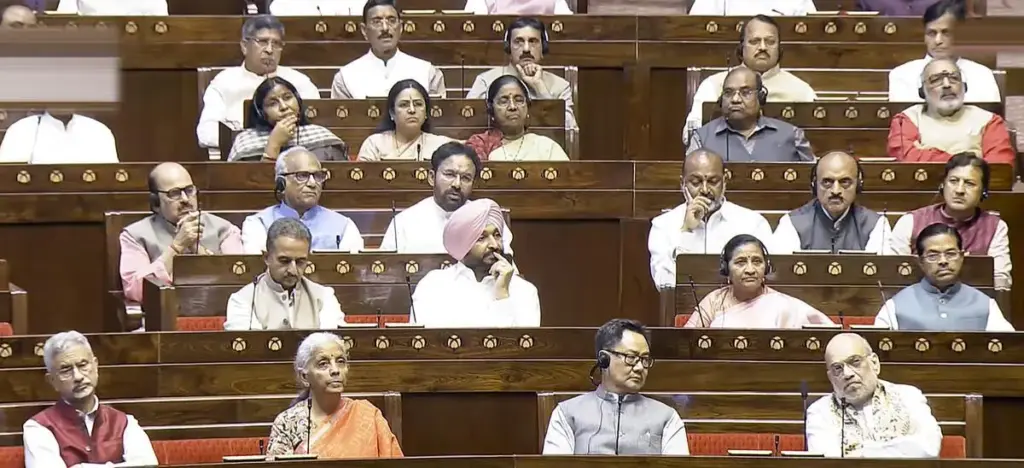
The BJP currently holds a comfortable majority in the Rajya Sabha, though its numbers have been gradually eroding as state election results fluctuate. Every seat matters in a chamber where certain legislative actions — constitutional amendments, joint sessions — require supermajorities or specific upper house assent.
Congress, for its part, is using this episode not just as a legal grievance but as a fundraising and mobilisation narrative. “Seat chori” — seat theft — is the hashtag circulating on X. It is blunt, it is memorable, and it is designed to stick.
Whether it sticks long enough to matter in the 2027 state election calendars is the more interesting question. India’s voters have a historical tendency to weigh governance delivery over procedural grievance. But when the two converge — when procedural manipulation affects actual policy representation — the calculation changes.
The Natarajan nomination is one data point. The pattern it joins is the story.