FAA Issues 60-Day Caution for Latin American Airspace Amid Regional Tensions

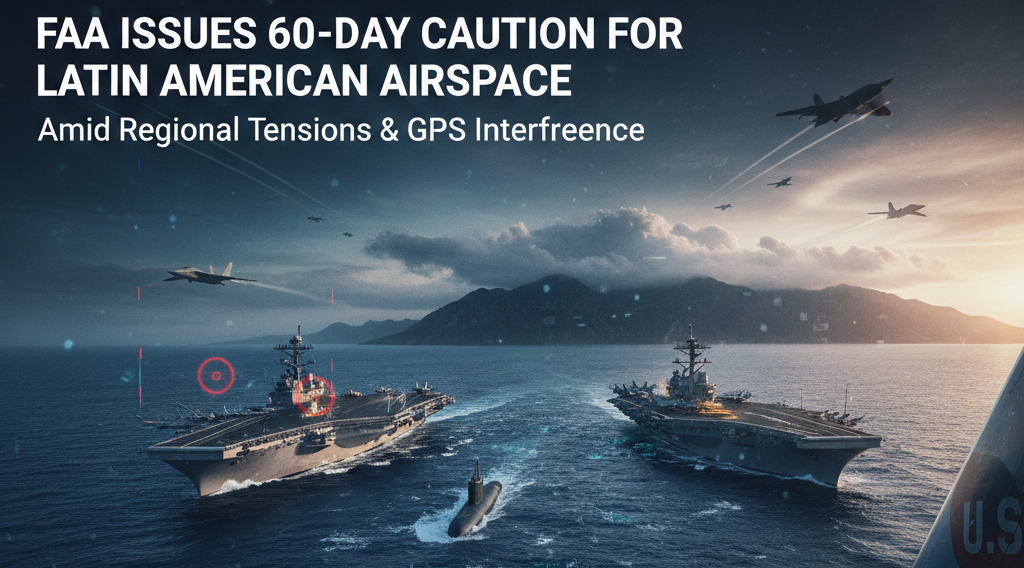
WASHINGTON, D.C. — The Federal Aviation Administration (FAA) has issued a significant safety advisory for U.S. airlines and pilots operating over Mexico, Central America, and parts of South America. The 60-day caution, effective as of January 16, 2026, warns of “potential military activity” and significant GPS interference that could impact civil aviation.
Scope of the Advisory
The FAA’s series of Notices to Airmen (NOTAMs) covers a vast area of the Western Hemisphere, specifically targeting:
- Mexico: Particularly overwater areas in the Pacific and Gulf of California.
- Central America: Airspace over Panama and the Central America Flight Information Region.
- South America: Key corridors over Colombia (Bogotá) and Ecuador (Guayaquil).
- Eastern Pacific: Wide swaths of oceanic airspace used for North-South transit.
The agency stated that risks exist for aircraft at all altitudes, including during overflight and critical arrival and departure phases.
Context: Rising Geopolitical Tensions
The advisory comes on the heels of major U.S. military movements in the region. Most notably, on January 3, 2026, U.S. special forces executed “Operation Absolute Resolve,” a high-stakes raid in Caracas that resulted in the capture of former Venezuelan President Nicolás Maduro and his wife, Cilia Flores.
The couple is currently in U.S. custody in New York facing federal charges related to narco-terrorism and drug trafficking. This operation has led to a significant buildup of U.S. naval and air assets in the Southern Caribbean and Eastern Pacific.
Technical Risks: GPS Jamming and Stealth Assets
A primary concern cited by the FAA is GNSS (Global Navigation Satellite System) interference. Pilots have been warned that GPS signals may be jammed or “spoofed” without notice, a common side effect of high-intensity military electronic warfare operations.
Furthermore, the FAA noted the potential for military aircraft to operate without transponders (the devices that make planes visible to civilian radar). This warning follows a near-miss last month involving a JetBlue passenger jet that had to take evasive action to avoid a U.S. Air Force tanker near the Venezuelan coast.
“Military activity and GNSS interference are not theoretical risks; they are operational realities in the region right now,” noted one aviation security analyst.
Regional Response
The Mexican government was quick to clarify that the advisory applies only to U.S.-registered operators. The Mexican Ministry of Infrastructure, Communications and Transport stated that its domestic airspace remains open and unaffected for Mexican carriers, describing the FAA’s move as a “precautionary measure” by a foreign authority.
Travel Impacts
While the NOTAM is not a flight ban, many U.S. airlines are reportedly reviewing their flight paths. Travelers heading to popular destinations in Mexico or South America may experience:
- Re-routing: Flights may take longer paths to avoid specific “caution” zones.
- Fuel Stops: Longer routes may necessitate additional refueling for certain aircraft.
- Schedule Variability: Increased vigilance and manual navigation checks by crews can lead to minor delays.