Davos 2026: Global Leaders Gather to Mend a Fractured World

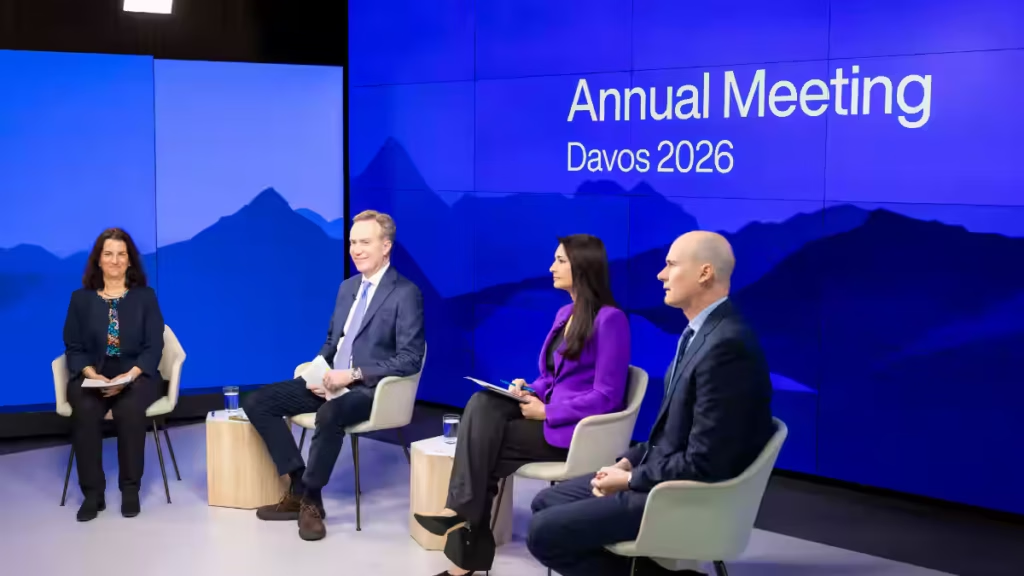
World leaders, top-tier executives, and influential policymakers are convening in Davos, Switzerland, for the 56th World Economic Forum (WEF) Annual Meeting, beginning January 19, 2026. Under the central theme, “A Spirit of Dialogue,” approximately 3,000 delegates from over 130 nations will spend five days addressing escalating geopolitical friction, the rapid expansion of artificial intelligence, and global economic resilience. High-profile attendees including U.S. President Donald Trump, Canadian Prime Minister Mark Carney, and French President Emmanuel Macron are expected to lead discussions aimed at fostering cooperation in an increasingly polarized international landscape.
High-Stakes Diplomacy on the Alpine Stage
The 2026 summit marks a record level of governmental participation, with roughly 400 political leaders and 65 heads of state scheduled to attend. The presence of President Trump, alongside a massive American delegation including Secretary of State Marco Rubio, signals a pivot toward intense bilateral negotiations on trade and security.
Meanwhile, Canadian Prime Minister Mark Carney and French President Emmanuel Macron are expected to champion “green” growth and digital ethics. The gathering serves as a critical junction for these leaders to move beyond crisis management and toward long-term strategic stability.
India’s Power-Packed Delegation
India has signaled its intent to play a decisive role in the global narrative by sending a formidable contingent. Four Union Ministers—Ashwini Vaishnaw, Shivraj Singh Chouhan, Pralhad Joshi, and K Rammohan Naidu—are leading the charge alongside six Chief Ministers.
More than 100 Indian CEOs, including industry titans like Mukesh Ambani and N. Chandrasekaran, are also on the ground. Their presence aims to showcase India as a stable, high-growth investment destination and a leader in digital public infrastructure.
Priorities for a Volatile Era
The forum has organized its agenda around five pillars designed to tackle the “fragmentation” of the modern world. These focus areas include:
- Cooperation in a Contested World: Finding common ground amid shifting alliances.
- Unlocking New Growth: Identifying economic drivers beyond traditional models.
- Investing in People: Addressing the skills gap in the age of automation.
- Responsible Innovation: Ensuring AI and quantum computing benefit society safely.
- Planetary Boundaries: Aligning economic prosperity with climate health.
Why This Matters: The Shift to “Dialogue”
In previous years, Davos often focused on “globalization” as an inevitable force. The 2026 theme, “A Spirit of Dialogue,” reflects a sobering realization: the world is no longer a single, cohesive marketplace.
By emphasizing dialogue, the WEF is acknowledging that “global” solutions are being replaced by regional “minilateralism.” This shift is crucial because it allows for progress even when superpowers disagree on fundamental ideologies.
Future Implications
The outcome of these talks will likely dictate the “rules of the road” for Generative AI governance and supply chain restructuring through 2030. If the Davos delegates can establish a shared framework for AI safety, we may see a more synchronized global tech economy. Conversely, failure to find common ground could lead to a “digital iron curtain,” where technologies and data are strictly siloed by geopolitical borders.
Summary
As the world watches the Swiss Alps this week, the focus remains on whether the “Spirit of Dialogue” can translate into tangible policy changes. With major elections and technological shifts looming, the 2026 Davos summit may be the last best chance for global elites to synchronize their strategies before the world fragments further.