CID Raids Mamata Banerjee’s Kalighat Home: BJP Minister Demands Arrest as Bengal’s New Power Order Tests Its Limits

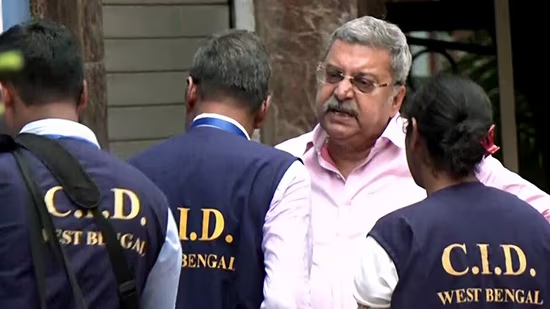
Investigators Enter Mamata Banerjee’s Kalighat Home as West Bengal’s Political Order Shatters
A CID search at the former Chief Minister’s residence — triggered in part by her own nephew’s legal submission — marks a dramatic new chapter in the collapse of the Trinamool Congress and the consolidation of BJP rule in India’s third-largest state.
KOLKATA, June 9, 2026 — When Crime Investigation Department officers pushed past security staff and entered the Kalighat residence of former West Bengal Chief Minister Mamata Banerjee on Tuesday afternoon, the images that circulated within minutes told a story far bigger than a single search warrant. This was not merely a law enforcement operation. It was a vivid, almost theatrical illustration of how completely the political order in India’s third-largest state has been upended in just five weeks.
Banerjee, the woman who ruled West Bengal for fifteen uninterrupted years, is no longer chief minister. She no longer controls the state police. She no longer decides who the CID investigates. And on Tuesday, she was in New Delhi — absent from her own home — when investigators arrived at 30B Harish Chatterjee Street with a contingent of officers, including women personnel from Kalighat police station, and a legal mandate to search the premises in connection with an alleged signature forgery case that has now split her party in two.
What the CID Was Looking For — and Why It Matters
The CID team visited Mamata Banerjee’s residence in connection with an alleged forged signature case. The case was filed after complaints were received from several Trinamool MLAs alleging that signatures of multiple legislators were forged on official documents submitted to the West Bengal Assembly.
The documents in question relate to a formal proposal, submitted to the Assembly Speaker, seeking official recognition for a breakaway faction of the Trinamool Congress. The probe targets alleged signature forgery that led 58 rebel MLAs to split the TMC.
The CID’s legal basis for entering the Kalighat office was provided, inadvertently, by Mamata’s own nephew. According to agency officials, the search was initiated after Abhishek Banerjee stated in a legal response that the legislative signatures currently under scrutiny had been compiled at this specific location.
That detail is legally significant. Abhishek Banerjee, the TMC’s national general secretary, had been summoned to appear before the CID at Bhabani Bhavan by 5 pm on Tuesday. His own written legal submission had effectively directed investigators to his aunt’s party headquarters — a turn of events that opposition politicians were quick to characterize as poetic.
The arrival of the CID team initially triggered a brief standoff, with party loyalists attempting to block entry in the absence of senior leadership, before investigators ultimately gained access. TMC leader Subhasish Chakraborty had initially told reporters the party would not permit a search until Abhishek Banerjee returned. That position did not hold.
“Nobody Is Above the Law”: The BJP’s Moment of Reckoning
The BJP’s response was immediate and unsparing.
West Bengal Minister Agnimitra Paul expressed stern criticism against TMC supremo Mamata Banerjee, stating that the former Chief Minister should be “booked and arrested” after a CID team arrived at her residence. Speaking to ANI, the Minister said the CID’s action reflects the supremacy of the Constitution and asserted that no individual is above the law of the land.
“Paul alleged that Banerjee, during her tenure as Chief Minister, misused her authority and allowed corruption and crime to flourish in the state, and alleged that the former Chief Minister had ‘cheated’ the people of West Bengal and made remarks against constitutional institutions, central forces, the Prime Minister, and the President.”
— Agnimitra Paul, Cabinet Minister, West BengalPaul’s remarks carry weight beyond rhetoric. She currently serves as Cabinet Minister in the Suvendu Adhikari government, holding portfolios for Urban Development & Municipal Affairs, and Women and Child Development Social Welfare. These are not the words of a backbench agitator. They represent the position of a serving minister in the state’s new ruling dispensation.
The Collapse of TMC: A Party in Freefall
To understand Tuesday’s events, you have to start with May 4, 2026 — the day the results of the West Bengal Assembly election were announced and the Trinamool Congress ceased to be the ruling party of the state it had dominated since 2011.
The BJP won the election in a landslide and became the first right-wing party to be elected to rule in West Bengal. In a major political upset, BJP leader Suvendu Adhikari defeated Chief Minister and TMC supremo Mamata Banerjee in the high-profile Bhabanipur assembly constituency by around 15,105 votes.
Adhikari was sworn in as Chief Minister on May 9, 2026, with his party securing 208 of 294 seats — a 71% legislative majority.
The scale of that defeat shattered the TMC’s internal cohesion almost immediately. Twenty TMC Members of Parliament formally addressed a letter to Lok Sabha Speaker Om Birla, expressing their desire to extend support to the NDA, signalling a potential shift in the political landscape of West Bengal and national parliamentary dynamics.
Now, 58 MLAs have reportedly broken away, and the signature forgery case sits at the heart of the fight over which faction constitutes the “real” Trinamool Congress for purposes of Assembly recognition — a dispute with serious implications for who can claim the party’s name, symbol, and legislative identity.
| Element | Detail |
|---|---|
| Date of CID Search | June 9, 2026 |
| Location Searched | 30B Harish Chatterjee Street, Kalighat, Kolkata |
| Basis of Search | Alleged forgery of TMC MLA signatures on Assembly documents |
| Rebel MLAs | 58 |
| Rebel MPs | 20 (wrote to Lok Sabha Speaker supporting NDA) |
| Current WB Chief Minister | Suvendu Adhikari (BJP, sworn in May 9, 2026) |
| BJP Minister Demanding Arrest | Agnimitra Paul (Urban Development & WCD Minister) |
| Where Mamata Was | New Delhi |
The Weaponization Question: Is This Justice or Politics?
The CID that raided Mamata Banerjee’s home on Tuesday is the same state CID that, for fifteen years, operated under her government. The investigating agency has not changed. The political authority directing state machinery has.
That symmetry is not lost on legal observers — or on the TMC.
“The use of state investigating agencies in Indian politics has always been a two-way street. What we are witnessing in West Bengal is a new ruling party deploying the same instruments of state power that the previous government was frequently accused of using against its own opponents. Whether the underlying cases have legal merit is a separate question from whether the timing and intensity of the action is politically motivated — and in Indian courts, that distinction matters enormously.”
— Dr. Ananya Roychowdhury, Constitutional Law Researcher, Presidency University, KolkataThe Trinamool Congress has historically accused the BJP-led central government of weaponizing the Enforcement Directorate and Central Bureau of Investigation against opposition-ruled states. Now, having lost power in Bengal, the TMC faces a state-level version of the same dynamic — this time with no Chief Minister’s office to call for protection.
According to an analysis by the Association for Democratic Reforms (ADR) published in March 2026, a pattern exists across Indian states where investigative action against the outgoing ruling party intensifies sharply in the first 12 months following a change of government — a cycle that ADR researchers describe as “institutional pendulum politics.”
A History of Confrontations: This Is Not New Territory
Mamata Banerjee has been here before — though always from the other side of the door.
In May 2021, the CBI arrived in West Bengal to arrest four sitting TMC ministers in the Narada sting operation case, where senior TMC leaders were allegedly caught on camera accepting cash. Banerjee responded by rushing to the CBI office herself and reportedly telling officials she should be arrested too — a defiant gesture that electrified her supporters.
In January 2026, just months before the election, the Enforcement Directorate raided the residence of I-PAC chief Pratik Jain in connection with a coal smuggling case. In an extraordinary turn of events, Banerjee herself arrived at Jain’s residence, emerged carrying documents and hard disks, and alleged that the raids were an attempt to seize the party’s candidate lists. The ED then approached the Calcutta High Court, alleging that the Chief Minister obstructed raids and investigations at Jain’s premises.
That episode, less than four months before the election, arguably hardened perceptions of Banerjee as someone who considered herself untouchable within her own state. Today, with a BJP government in Writers’ Building, that perception is being actively used against her.
What the TMC Says — and What It Cannot Say
The TMC’s formal response to Tuesday’s events has been muted by the enormity of its situation. With 58 MLAs having broken away, 20 MPs reportedly defecting to the NDA, and the party’s own general secretary having inadvertently pointed investigators toward the party headquarters, the usual arsenal of outrage and street mobilization looks considerably depleted.
Senior TMC leaders privately acknowledge, according to political sources in Kolkata, that the signature forgery case is potentially more damaging than any of the central agency cases of recent years — precisely because it is a state-level CID investigation under the new BJP government, not a central agency action that can be framed as “Delhi’s interference.” The narrative of victimhood by a hostile Centre, which served Banerjee well for years, does not apply when the state’s own police machinery is doing the investigating.
“The TMC’s greatest rhetorical weapon was always the Centre-vs-Bengal framing. That weapon doesn’t work when it’s the state CID at the door, acting under a state government that won a democratic mandate. The party is in genuinely uncharted territory.”
— Priya Sharma, Senior Political CorrespondentThe Legal Road Ahead
For all the political drama, the legal picture remains unresolved — and Indian courts have a long history of complicating what politicians present as open-and-shut cases.
A report by the Vidhi Centre for Legal Policy, published in 2025, found that politically sensitive cases in Indian state courts took an average of 4.2 years from initial charge-sheet to final verdict, with high-profile cases involving former chief ministers averaging closer to seven years. Charges of evidence tampering or obstruction, if lodged, add further complexity.
Whether Mamata Banerjee is ever formally “booked and arrested,” as Agnimitra Paul demands, will depend on what CID investigators find at Kalighat, what Abhishek Banerjee says in his deposition, and how the Calcutta High Court responds to any constitutional challenges the TMC is almost certain to mount.
What is not in doubt is that June 9, 2026, marks a turning point in the long political biography of one of India’s most combative leaders. The woman who once dared the CBI to arrest her is now watching investigators enter her own home — in a state where she no longer writes the rules.
This article reflects information available as of June 9, 2026. Legal proceedings referenced are ongoing and no guilt has been established by any court. Expert commentary represents individual analytical positions and not institutional positions.