The New Space Race: Why Nations and Billionaires Are Competing for the Moon — and What It Means for Earth

Return to the Moon: A New Space Race With Stakes That Reach Beyond the Lunar Surface
National governments, private billionaires, and rival powers are converging on the moon — driven by water ice, rocket fuel, geopolitical ambition, and the long-term future of human civilisation.
The moon, which humanity first visited more than half a century ago and then largely set aside as a destination, has become the focal point of an intensifying new space race involving national governments, private technology billionaires, and a geopolitical competition with stakes that extend far beyond the lunar surface.
Why the Moon, Why Now?
When NASA’s Apollo astronauts last walked on the moon in December 1972, the general assumption was that human return missions would follow within years. That did not happen. For decades, the moon receded in ambition and budgets, replaced by Earth-orbital space stations, robotic planetary missions, and eventually the Space Shuttle program.
What has changed is both technological and political. Advances in rocket technology — particularly the development of reusable launch vehicles — have dramatically reduced the cost of reaching space. Computing power that once filled entire buildings now fits in a pocket. Materials science and life support technology have advanced significantly. And critically, scientific analysis of lunar samples and data from orbital probes has revealed something that changes the strategic calculus entirely: the moon contains significant deposits of water ice, particularly at its poles.
Water ice on the moon is not just scientifically interesting — it is potentially transformative for future space exploration. Water can be split into hydrogen and oxygen, producing rocket propellant. This means a permanent lunar base could theoretically manufacture its own fuel, turning the moon from a destination into a refueling station for missions to Mars and beyond. Whoever controls reliable access to the lunar poles may hold a decisive advantage in the long-term human exploration and settlement of the solar system.
The Players
NASA and the Artemis Program represent the United States’ primary effort to return humans to the moon. The Artemis program aims to land American astronauts — including the first woman and first person of color to walk on the lunar surface — at the moon’s south pole. After a series of delays, Artemis has made significant progress, with crewed missions targeting the latter half of this decade.
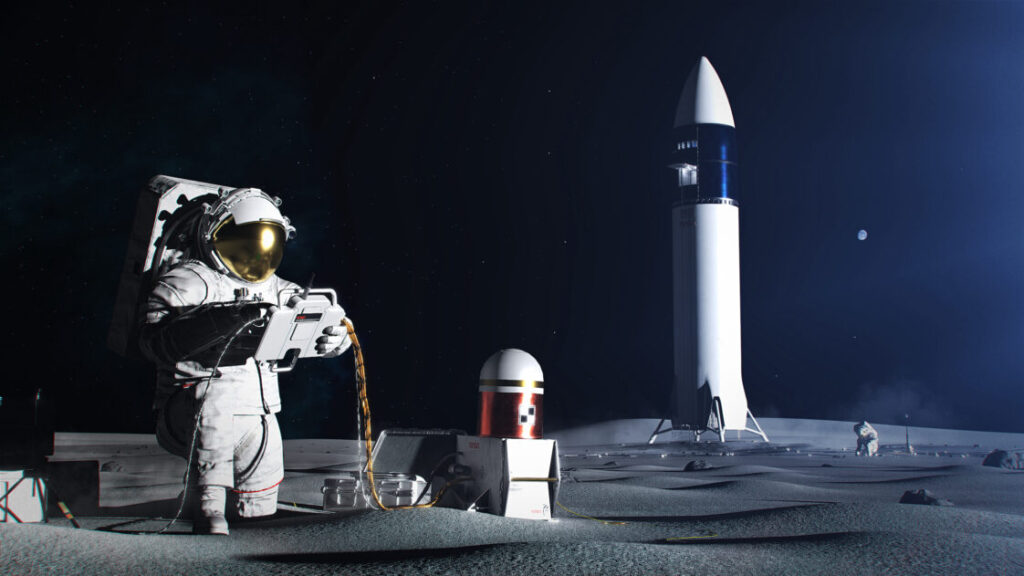
NASA has partnered with the European Space Agency, the Canadian Space Agency, and the Japan Aerospace Exploration Agency, along with a growing network of commercial partners. SpaceX, founded by Elon Musk, is developing the massive Starship launch vehicle as the designated Artemis lunar landing system — a partnership that has generated both excitement and controversy given the central role played by a private company in a flagship national mission.
China has mounted arguably the most impressive recent run of lunar achievement. The Chang’e series of robotic missions has landed successfully on both the near and far sides of the moon, including the historic Chang’e 4 mission to the lunar far side — a world first. China has returned fresh lunar samples to Earth, the first such samples collected since 1976, and has announced an ambitious plan to build a permanent International Lunar Research Station at the moon’s south pole, in partnership with Russia, by the mid-2030s.
Chinese space officials have explicitly framed lunar exploration in terms of national pride and strategic resource access, and American officials have taken note. NASA Administrator Bill Nelson has repeatedly warned in congressional testimony that if China establishes a dominant presence at the lunar south pole, it could attempt to exclude other nations from the most scientifically and strategically valuable locations — an accusation that Chinese officials reject.
India has emerged as a significant space power following the stunning success of the Chandrayaan-3 mission in August 2023, which made India only the fourth country to achieve a soft lunar landing and the first to successfully land near the south pole. The achievement was a source of enormous national pride in India and demonstrated that ambitious space exploration is no longer limited to the traditional superpowers.
Private Companies are increasingly central to the new space race in ways that would have been unimaginable during the Apollo era. Beyond SpaceX, companies like Blue Origin (founded by Amazon’s Jeff Bezos), Astrobotic, and Intuitive Machines are developing lunar landers, transport systems, and surface equipment. The commercial space industry is evolving from a provider of satellite services to an active participant in deep space exploration, with business models built on resource extraction, tourism, and the provision of infrastructure for government missions.
The Artemis Accords and Lunar Governance
The legal framework governing activity on the moon is, to put it charitably, underdeveloped. The 1967 Outer Space Treaty established the principle that space is the “province of all mankind” and cannot be claimed by national sovereignty, but it was written in an era when the commercial exploitation of space resources was science fiction.
The United States has led the development of the Artemis Accords, a set of bilateral agreements with partner nations that establish norms for safe operations, data sharing, and — controversially — the right of nations to extract and use space resources for commercial purposes. More than 40 countries have signed the Accords.
Russia and China have declined to sign and have criticized the Accords as an attempt by the United States to write the rules of space governance in its own interest. They are developing their own framework, creating a situation in which two competing and potentially incompatible governance systems are being established simultaneously.
40+ signatories
Includes commercial resource rights
Declined to sign Accords
Developing separate standards
The Implications for Earth
Beyond the adventure and the competition, why should people without a particular interest in space care about the new lunar race?
The technologies developed for space exploration have a long history of generating terrestrial benefits — from communications satellites to GPS to medical imaging advances. The development of lightweight, efficient solar panels, advanced water recycling systems, and high-density energy storage for lunar missions could accelerate the clean energy transition on Earth.
More broadly, the new space race reflects and reinforces the larger geopolitical competition, particularly between the United States and China, that is reshaping international relations across every domain. The decisions made about who leads in space, and under what rules, will affect international prestige, strategic confidence, and the global balance of power.
For humanity as a whole, the prospect of becoming a multiplanetary species — beginning with a permanent presence on the moon — represents something genuinely unprecedented: the expansion of civilization beyond the world where it was born.
Whether that expansion happens cooperatively or competitively, wisely or recklessly, will be determined in the coming decade.
Key Dates & Milestones